
expedia
One Key

Earn OneKeyCash when you sign in and book an activity
Ten Lakes Tour and Ullswater Cruise Experience 1
Ten Lakes Tour and Ullswater Cruise Experience 2
Ten Lakes Tour and Ullswater Cruise Experience 3
By English Lakes Tours
Free cancellation available
Price is AU$303 per adult

Features

  • Free cancellation available
  • 7h
  • Mobile voucher
  • Instant confirmation

Overview

  • Other operators run a ten-lakes tour. None of them put you on the water. This is the only ten-lakes tour in the National Park that includes a genuine hour-long cruise on Ullswater — pre-booked, included, no extra cost on the day — aboard a steamer sailing this lake since 1859. While other tours drive past and point, you'll feel the lake from its surface, Place Fell rising sheer from the shore, the whole basin opening out around you. The same depth applies elsewhere: at Honister, your guide explains the centuries of industry carved into that cliff face, not just a photo of the mine. At Buttermere, widely considered the most beautifully proportioned lake in the district, you'll understand why it's been celebrated since the earliest days of Lake District tourism. With only seven guests aboard, every question gets answered properly, across four mountain passes and ten lakes most visitors never see in a single trip.

Activity location

  • Kirkstone Pass
    • Ambleside, United Kingdom

Meeting/Redemption Point

  • Windermere Station Taxi
    • Windermere Railway Station Station Road
    • LA23 1AH, Windermere, England, United Kingdom

Check availability

Ten Lakes Tour and Ullswater Cruise Experience

  • Activity duration is 7 hours7h
    7h
  • English
Language options: English
Starting time: 9:35 AM
Price details
AU$303.42 x 1 AdultAU$303.42
Total
Price is AU$303.42
Until Fri, 7 Aug

What's included, what's not

  • What's includedWhat's included
    Ullswater Steamers cruise ticket (pre-booked, included)
  • What's excludedWhat's excluded
    Lunch

Know before you book

  • Service animals allowed
  • Public transport options are available nearby
  • Suitable for all physical fitness levels

Activity itinerary

Kirkstone Pass

  • 10m
The route to Kirkstone Pass begins quietly — a lane climbing out of the Windermere valley through rolling green fields, sheep grazing on either side, the road winding upward in a way that feels unhurried and unlike the main routes from Ambleside. Your guide calls a stop for one of the finest views on the whole tour: Windermere laid out below you in its full length, the water catching the light, Claife Heights rising as a dark wooded ridge on the opposite shore. The kind of view that reminds you why this landscape was given World Heritage status — seen not from a car park or a designated viewpoint, but from the side of a quiet lane that most visitors never find. From here the road continues through Troutbeck and onto the Kirkstone road, the valley floor falling further away with every bend until the fells close in and the full drama of the pass opens out above you. One of those moments that makes people understand, without needing to be told, exactly why they came.

Windermere

  • 5m
Your full day begins right here, outside Windermere station — the main rail gateway into the Lake District and the starting point for one of the most spectacular days out in England. Booths supermarket is right next door inside the old station building, with toilets if you need them before we set off. Windermere itself sits half a mile from the lake that shares its name — a fact that surprises plenty of first-time visitors — and has been the arrival point for Lake District explorers ever since the railway reached it in 1847. Wordsworth famously opposed the line, fearing it would spoil the tranquillity of the valley. Looking around at the visitors it brings, and the landscape they come for, you can see both sides of the argument. From here, ten lakes, four mountain passes and a full day of spectacular scenery await. Please be ready on time — there's a great deal to fit in, and every minute of it is worth having.

Bowness-on-Windermere

  • 5m
Ambleside is the final pickup of the morning, with collection from Kelsick Road, right outside the public library with its big glass windows and opposite the bus interchange where the local public buses come and go — easy to find, right in the heart of the village. After Windermere and Bowness, you are the last aboard, and from here the day begins in earnest: ten lakes, four mountain passes, a genuine hour-long Ullswater cruise and some of the most spectacular scenery in England, all in the company of an expert storyteller who knows every tale this landscape has to tell. There's a full, extraordinary day ahead, so we're always keen to get going on time and make the most of every minute. From here the minibus heads out through the village, the high street giving way to open countryside as Windermere falls behind and the bigger fells start to come into view. Ambleside has long been the true gateway to the heart of the Lake District. Today, it really is — for you.

Ambleside

  • 5m
pickup

Kirkstone Mountain Pass (Pass by)

The Kirkstone Inn marks the summit of the pass — the highest inhabited building in the National Park at 1,489 feet, and one of the most dramatically situated in England. It has stood on this windswept plateau since the 17th century, originally a staging post for travellers crossing the pass on foot or by horse, a place to take shelter before the long descent. Reimagined recently as a place to stay, its historic bar has just reopened under a local microbrewery — a welcome return. You stop here to step out and take in the view looking back down the way you've come: the valley floor far below, Windermere glinting in the distance, Esthwaite Water visible beyond it, and on the clearest days the Irish Sea shimmering on the horizon. The inn is said to be haunted — the spirit of a woman who perished crossing the pass in a blizzard still walks its corridors. Standing here with the wind coming fresh off the fells, it doesn't feel entirely unlikely.

Brothers Water (Pass by)

The road winds dramatically down from the pass into the Hartsop valley, the twin slopes of Hartsop Dodd and High Hartsop Dodd rising steeply on either side, until Brothers Water appears at the valley bottom — small, shallow, perfectly still on a quiet morning, its reedy edges and the fells above them doubled in the surface. One of the most peaceful corners of the Lake District: a place walkers pass through rather than come to, the hamlet of Hartsop just behind you, its 17th-century cottages with their original timber spinning galleries where local families worked hand looms through every long winter. In summer, water lilies open across the shallows. The name Brothers Water has a storey behind it that your guide will tell — one of those quiet local tragedies that attaches itself to a landscape and refuses to leave, so that you find yourself looking at the water differently once you've heard it. It happened here, on this water, in January 1786. The lake has carried the name ever since.

Patterdale (Pass by)

Patterdale sits quietly at the foot of some of the most dramatic fells in the Lake District, the valley road running through it unhurried, walkers setting off for Helvellyn and the knife-edge of Striding Edge above. It has the quality of a place that has never needed to announce itself — it simply is, and has been, for a very long time. Alfred Wainwright, whose hand-drawn guides to these fells became classics, called this his favourite valley of them all. As you leave the village, your guide traces High Street along the ridge to the right — the Roman road, still visible as a diagonal line cutting across the open fellside, two thousand years old and hiding in plain sight. Then, by the roadside, St Patrick's Well: a spring where legend says the saint himself descended this valley in the 5th century, baptising local people in the name of a faith that would reshape Britain. The valley has been St Patrick's Dale ever since. Some names stick because they deserve to.

Ullswater

  • 15m
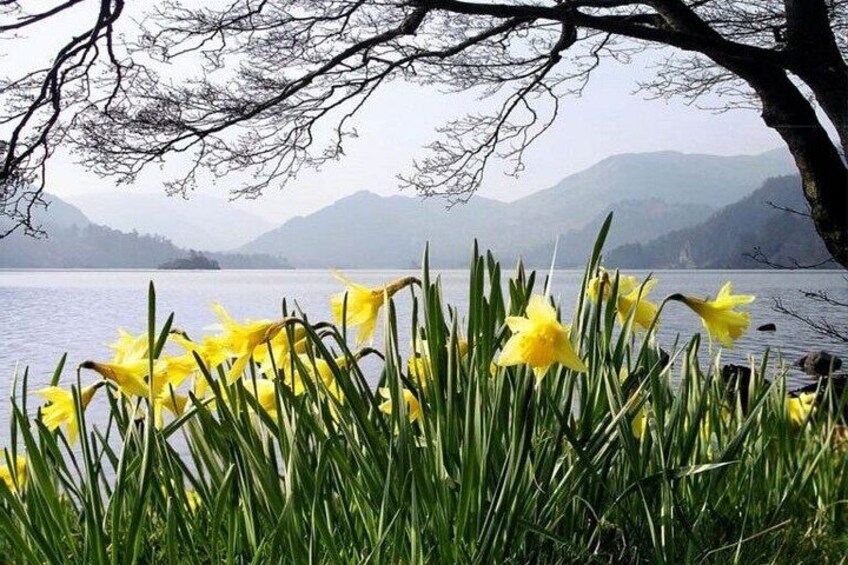
Ullswater is often called England's most beautiful lake — and standing at Glenridding pier, looking down its full length for the first time, it is easy to see why. Eight miles long, curving in a long gentle S-bend through mountains that press right down to the water's edge, the surface shifting between silver, slate and deep black as the light moves across the fells. Sometimes it is glassy and still, the mountains doubled in it, the whole basin wrapped in a silence that feels almost physical. Sometimes the wind comes off Helvellyn and the lake turns dark and restless, waves catching the light, the whole mood of the place changing in minutes. Either way, few lakes in England have this quality — something wilder and more remote about it than the lakes further south, something that makes you want to stay rather than simply look. From here, you board a steamer and spend an hour on the water itself, the mountains moving slowly past, the shore retreating, the lake opening out all around you.

Ullswater Steamers

  • 1h
  • Admission ticket included
The Ullswater Steamers have been carrying passengers on this lake since 1859. Your ticket is included in the tour price, pre-booked, and this hour on the water is entirely yours: no guide, no commentary, no schedule beyond the one the steamer keeps. Most ten-lakes tours drive past Ullswater. This one puts you on it — the only ten-lakes tour in the National Park that does. Find a seat on deck or inside, watch the mountains shift as the boat makes its way up the lake, or simply sit in silence with one of the finest views in England moving past. Place Fell rises sheer from the eastern shore. Helvellyn fills the southwestern skyline. The lakeshore comes and goes — jetties, boathouses, the occasional figure watching from the bank. The lake looks quite different from its surface than from the road — wider, deeper, more extraordinary, more entirely itself. An hour on Ullswater is not easily forgotten. At Pooley Bridge, your minibus will be waiting — and a spectacular afternoon still to come.

Glenridding

  • 10m
Glenridding is the starting point for your cruise on Ullswater — a compact fell-walking village at the southern end of the lake, with Helvellyn rising steeply behind it and the pier just ahead. On any morning the paths above are already busy with walkers heading for England's third-highest mountain and the famous knife-edge of Striding Edge. The village grew up around the Greenside lead mine, once the largest in the Lake District, its shafts running 3,000 feet beneath the mountain until it finally closed in 1962. What replaced the industry is walkers, lake visitors and the elegant Victorian steamer pier at the water's edge. Stand here for a moment: Helvellyn behind you, eight miles of mountain lake stretching away to the north, the water catching the light. This is where the tour changes register entirely — where road and storey give way to open water, fresh air and a view that cannot be replicated from any shore. The boat is coming. The best part of the morning is about to begin.

Pooley Bridge

  • 5m
Pooley Bridge sits at the northern end of Ullswater, where the lake narrows and flows into the River Eamont — a pretty village of stone buildings, a bridge, cafés and a green beside the water. This is where your minibus meets the steamer, and where the second half of the day begins. After an hour on the lake, the transition back to road feels different — the scale of what you've just crossed still with you, mountains retreating as the valley opens north. Take a moment to look back down Ullswater before you board: the lake stretching away to the south, the mountains closing in on either side, the same view that made it famous. Pooley Bridge itself was rebuilt after a devastating flood in December 2015 washed the original 18th-century bridge away. The new one, opened in 2020, was built to last. And now the day continues: Blencathra and Castlerigg, Keswick and lunch, Borrowdale and Honister Pass, Buttermere and Moss Force — some of the most spectacular scenery in England still to come.

Dacre (Pass by)

Dacre is one of those small villages that rewards a slow drive through — a handful of stone cottages along a quiet lane, and the battlements of Dacre Castle visible above the rooftops: a 14th-century pele tower built to guard against Scottish raids, reputed to be haunted, and still in private hands today. Your guide will tell you about the Norman church of St Andrew's just out of sight, on a monastery site recorded by the Venerable Bede in the 8th century. In its churchyard stand four stone bear sculptures, one at each corner, about four feet tall and carved from red sandstone — Grade II* listed, probably medieval, and nobody knows what they mean or where they came from. One theory suggests they tell a storey across the four figures. Nobody has proved it. The village name comes from the Celtic word for "tear." It is the kind of quietly extraordinary place the Lake District has in abundance — and that most visitors drive straight through without ever knowing.

Blencathra [Saddleback] (Pass by)

Blencathra fills the horizon as the road runs beneath it — one of the most dramatic mountains in the Lake District, its vast southern face dropping steeply to the valley floor, every ridge and gully visible from below in a way that few mountains allow. Also known as Saddleback, for the shape of its summit seen from the east, it is the kind of mountain that stops conversation without asking. Your expert storyteller will point out Sharp Edge on the upper eastern flank — the knife-edged arête that Wainwright, who wrote the definitive walking guides to these fells, described as having a crest "sharp enough for shaving." He was not entirely joking. Sharp Edge is one of the most dangerous scrambles in England, with Keswick Mountain Rescue called out there every year. From the road below, the scale of Blencathra is extraordinary — the fells rising on every side, but this one rising differently, more urgently, as if the mountain has something to say and is saying it at full volume.

Castlerigg Stone Circle

  • 20m
  • Admission ticket included
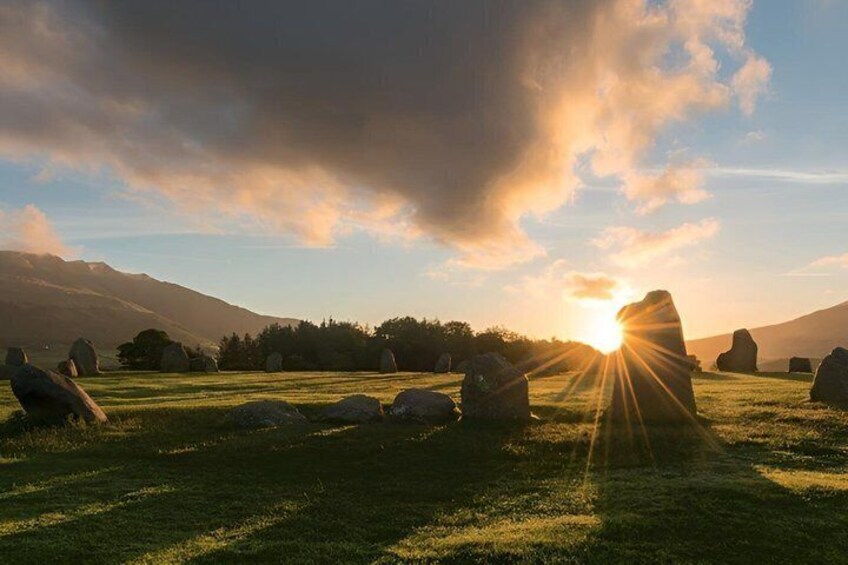
Everyone comes to Castlerigg. The difference is how. Most arrive in a sixteen-seater minibus, step out in a large group, take a photograph and climb back in. You step inside — walk freely among the stones, lay your hands on Borrowdale volcanic rock, feel the roughness of something that has stood through every season, every storm, every civilisation since it was placed here nearly five thousand years ago. Thirty-eight standing stones, some up to seven feet tall, on a plateau above Keswick with mountains rising on every side — Helvellyn, Skiddaw, Blencathra — older than Stonehenge. Your expert storyteller is beside you, the experience intimate and conversational: explaining the alignments, the solstice sunrise, the way people still gather here every year in the dark of winter to watch the sun rise between the stones. Every question gets a proper answer. Most visitors feel the atmosphere but can't explain it. With someone who knows the language of this place beside you, you can.

Keswick

  • 1h
Keswick is your lunch stop, and it is one of the finest places in the Lake District to spend an hour — a proper northern market town, full of life and character, with the kind of streets that make you want to turn down every alley and into every doorway. Independent cafés and good pubs line the centre, the smell of food drifting out onto the pavement, the fells visible above the rooftops in every direction. If you're here on a Thursday or Saturday, the outdoor market will be in full swing in the historic Market Square — a riot of local food, craft and colour that has occupied this same spot since Edward I granted the town its charter in 1276. A ten-minute walk leads to the shores of Derwentwater, the Theatre by the Lake right at the water's edge and Catbells rising across the surface. You won't see all of it today. But even a glimpse of Keswick at its best is enough to understand why people come back to this town, again and again, whenever they are near the northern Lakes.

Borrowdale (Pass by)

The road south from Keswick follows the western shore of Derwentwater deep into Borrowdale — steep wooded fells rising on either side, the lake flickering to your right through the trees, the landscape growing wilder and more dramatic with every mile. Your expert storyteller brings it to life as you go: the geology carved by ice, the ancient woodland unchanged for centuries, the farming life barely changed since medieval times. The valley road eventually reaches the Jaws of Borrowdale, where the fells close in from both sides and Castle Crag and Grange Fell squeeze the River Derwent into a narrow gorge. The trees arch overhead, the road narrows, and the whole atmosphere changes — as if the valley has decided to test whether you really want to go further. You do. Wainwright called the valley floor beyond "the loveliest square mile of Lakeland," and anyone who has driven through the Jaws and emerged into the open valley beyond will understand exactly why he felt so strongly about it.

Derwentwater (Pass by)

Derwentwater — the Queen of the Lakes — opens out to your right as the road winds south, Catbells rising in a long shapely ridge on the far shore, the water light and restless, boats making quiet crossings between wooded jetties. Later you will see it quite differently — from high above, the full picture suddenly opening out. For now, let it arrive at this pace and from this level: intimate, enclosed, the islands close enough to feel as though they belong to you. St Herbert's Isle, where a 7th-century hermit chose to live alone in prayer and silence. Derwent Isle, where a Georgian eccentric built himself a house and staged mock naval battles for the entertainment of visitors. And threading through it all, Beatrix Potter — who spent nine summer holidays on this shore, fell in love with it, and drew it so obsessively that when she wrote The Tale of Squirrel Nutkin, St Herbert's Isle became Owl Island almost without thinking. The landscape you are moving through is one she loved.

Surprise View

  • 10m
  • Admission ticket included
Most tourists that come to Surprise View arrive from the main road below — a car park, a walk up, a viewpoint shared with whoever else is there. You arrive differently: up a narrow, winding lane through dense woodland, too steep and narrow for most drivers to attempt, the trees pressing in until without warning they clear and Derwentwater opens out below you. The name is exactly right — you cannot see it coming. One moment the woodland is all around you, secluded, mossy, draped in its own particular silence. The next, the whole lake is below: Catbells rising sheer on the opposite shore, the River Derwent snaking into Borrowdale, a view that has been stopping people in their tracks for as long as anyone has been finding their way here. It rewards the approach — the narrow road, the secret feeling of it, the sense of having arrived somewhere most visitors never find this way. With a group this small and a driver who has done it a hundred times, you simply arrive. And there it is.

Ashness Bridge

  • 10m
  • Admission ticket included
see

Bassenthwaite Lake (Pass by)

see in distance

Catbells Lakeland Walk

  • 10m
  • Admission ticket included
see

Rosthwaite (Pass by)

village

Seatoller (Pass by)

village

Seathwaite (Pass by)

village

Gatesgarth (Pass by)

village

Buttermere Lake (Pass by)

lake

Crummock Water (Pass by)

lake

Newlands Pass (Pass by)

raise

Moss Force Waterfall

  • 10m
  • Admission ticket included
see

Newlands Valley (Pass by)

valley

Stair (Pass by)

drive

Portinscale (Pass by)

village

Naddle (Pass by)

see

Thirlmere (Pass by)

see

Dunmail Raise (Pass by)

see

Helm Crag (Pass by)

see

Grasmere (Pass by)

vale of

Grasmere

  • 10m
village

The Grasmere Gingerbread Shop

  • 10m
  • Admission ticket included
shop

Lake Grasmere (Pass by)

lake

Wordsworth Grasmere (Pass by)

dove cottage

Rydal Water (Pass by)

see

Rydal (Pass by)

hamlet

Honister Slate Mine

  • 10m
  • Admission ticket included
see

Troutbeck (Pass by)

Troutbeck takes a moment to reveal itself — and that moment is worth everything. There is no obvious centre, no market square: just a long, straggling lane of 17th-century farmhouses, barns and cottages following the contour of the hillside, the kind of village that has barely changed in three hundred years and doesn't especially want to. Your guide points out Townend as you pass — a handsome yeoman farmhouse whose carved oak furniture, beams and possessions were left exactly as the same family kept them for three centuries. In the valley bottom, Jesus Church has a window by Burne-Jones, Morris and Ford Madox Brown, glowing in the morning light as it has since 1873. The Mortal Man alehouse has been pouring ale since 1689, its sign painted by Julius Caesar Ibbetson in payment for a fishing holiday. These are the details most people drive through without seeing — always been there, always will be, quietly waiting for you to discover them with a guide who knows them all.

Location

Activity location

  • LOB_ACTIVITIESLOB_ACTIVITIES
    Kirkstone Pass
    • Ambleside, United Kingdom

Meeting/Redemption Point

  • PEOPLEPEOPLE
    Windermere Station Taxi
    • Windermere Railway Station Station Road
    • LA23 1AH, Windermere, England, United Kingdom

Best Deals on Things to Do

Experience the wonders of the world up close with great deals on things to do near and far. Expedia offers one-of-a-kind activities that allow you to explore Ambleside your way. Whether you love nature, culture, food or a bit of adventure, we have the perfect activity for you.

Top experiences in Ambleside

With so many activities in Ambleside, planning the perfect day out may seem like a daunting task. Expedia is here to take the hassle out of finding the best attractions, tours and activities in Ambleside. Families, couples and business travellers can all find the perfect activity in Ambleside to create life-long memories with the help of Expedia.