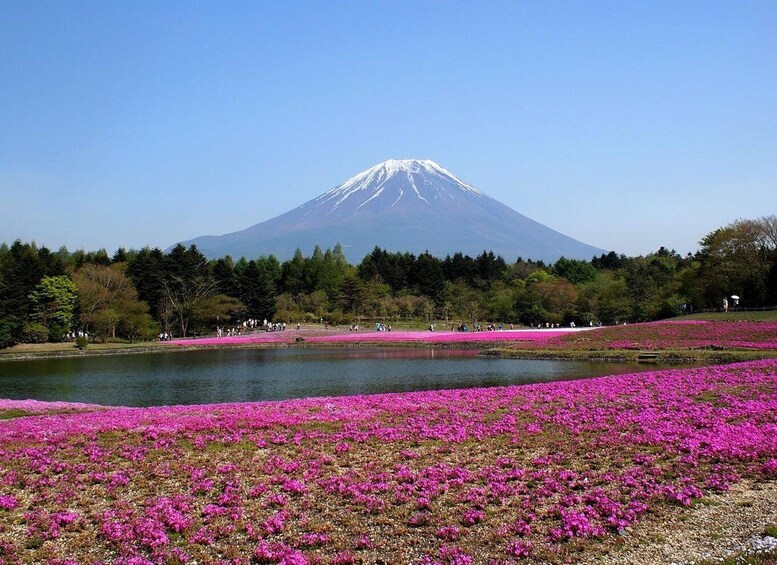
Before we arrive at Mount Fuji, let me start with a storey from Japanese mythology. The Sakura Goddess, Konohanasakuya-hime, represents a very important idea in Japan: beauty is most powerful when it does not last. Like cherry blossoms, it reaches its peak and then disappears.
Mount Fuji represents the opposite. It is eternal, silent, and unchanged for thousands of years. In Japanese aesthetics, these two forces always exist together—the fleeting flower and the eternal mountain.
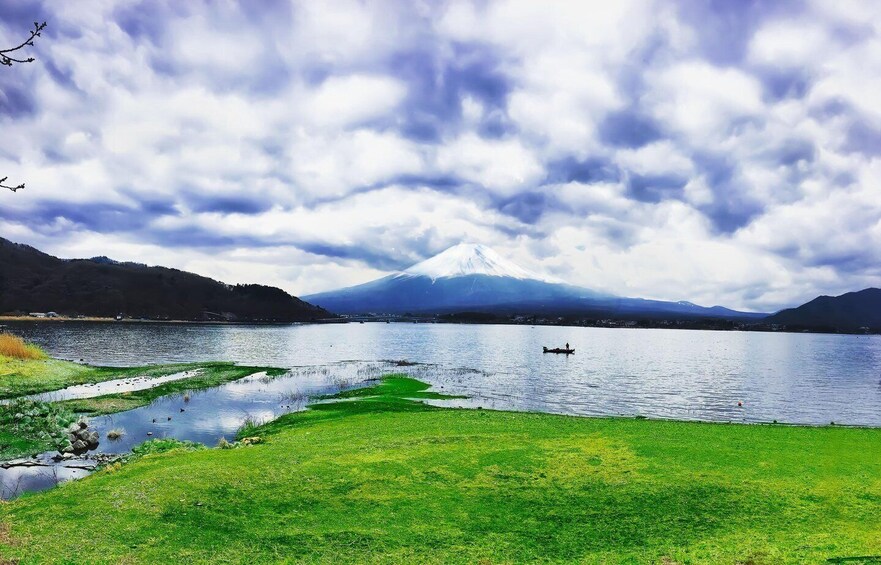
At Lake Yamanakako, you first see Mount Fuji reflected on still water. It feels calm and almost unreal, like time has stopped. This is the idea of “ma”, where emptiness and silence become part of beauty.
At the Lawson viewpoint, everyday life and sacred nature exist in the same frame. A simple convenience store stands in front of Mount Fuji, showing how Japan does not separate the ordinary from the divine.
At Oishi Park, flowers change every season while Mount Fuji never changes. This contrast is what Japanese culture calls mono no aware—the awareness that beauty becomes more powerful because it is temporary.
At the Clock Street, the road leads directly towards the mountain. It feels like walking through perspective itself, a sense of depth that Japanese culture calls yūgen—something you feel but cannot fully explain.
At the shrine gate, you pass into a symbolic sacred space. Here, Mount Fuji is not just a mountain, but a living presence connected to ancient mountain worship.
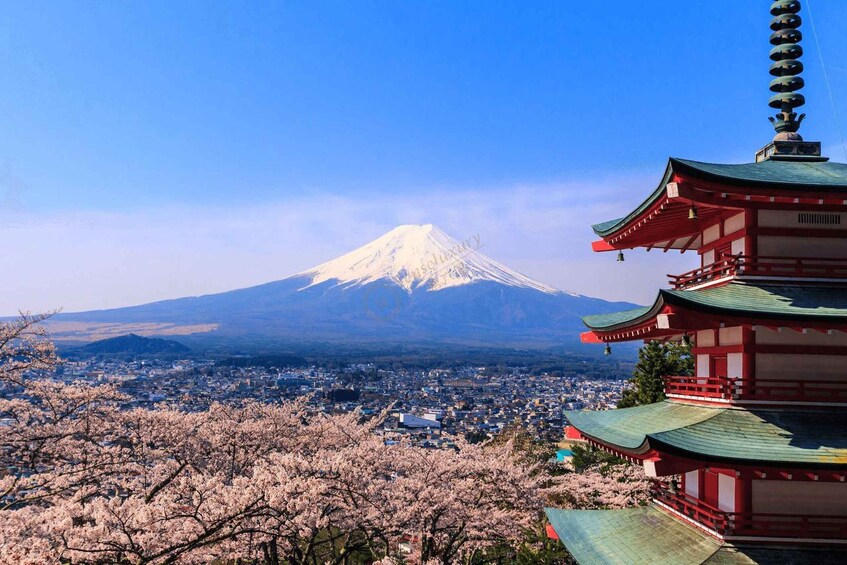
Finally, at Arakurayama Sengen Park, cherry blossoms, a pagoda, and Mount Fuji come together in one perfect frame. It is not just a view—it is Japan’s aesthetic philosophy made visible.
In the end, this is not about seeing Mount Fuji. It is about understanding how Japan sees beauty—between what lasts, and what disappears.