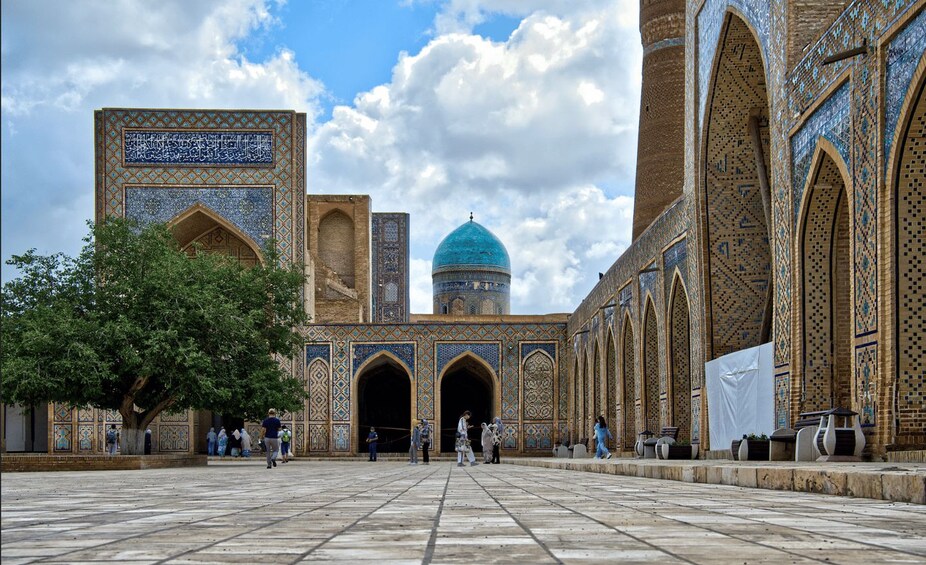
In 1220 Genghis Khan burned most of Bukhara but left the Kalyan Minaret standing. Locals say he tipped his head back to see the top, his hat fell off, and he had to bend down to pick it up. A tower that made the Khan bow could stay.
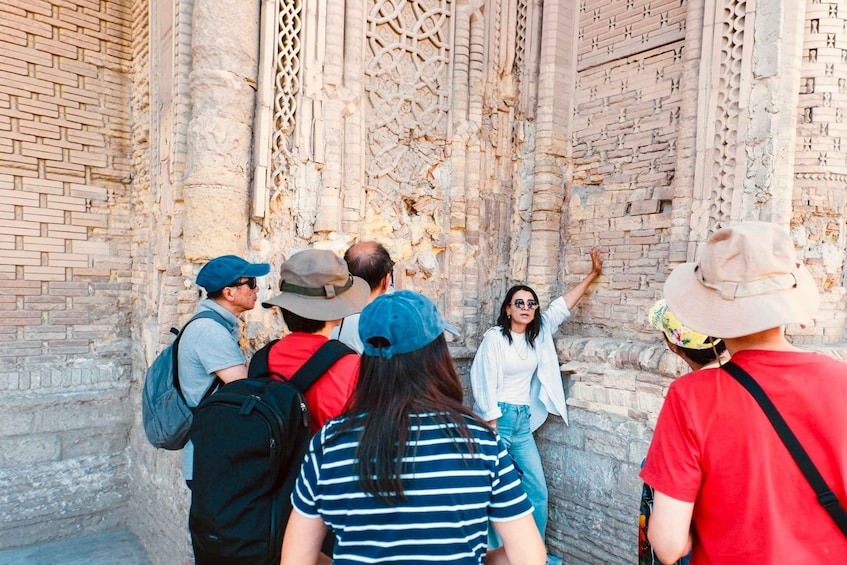
This walk takes you through the city century by century, so by the end the old town makes sense. It starts at the Samanid Mausoleum, a brick cube from around the year 900 whose patterns seem to shift as the sun moves. People once dropped written petitions through an opening on its south side and checked the north side for an answer. Today it's simpler: walk around it three times, anti-clockwise, and make a wish. Next door, Chashma-Ayub stands over a spring the prophet Job is said to have opened with his staff. Its cone-shaped dome, rare in Bukhara, was built by craftsmen from Khorezm in Timur's time.
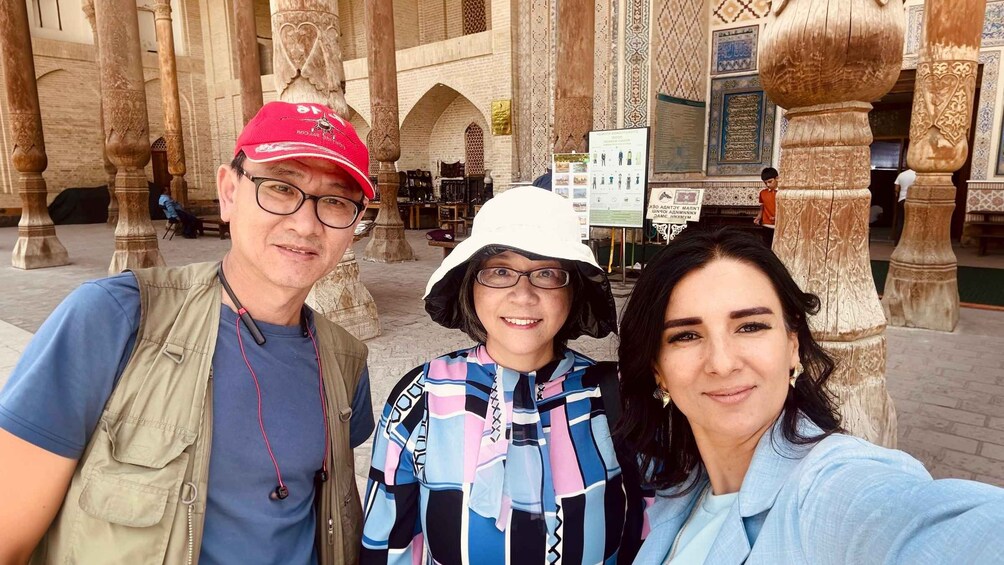
Across the road from the Ark, the emir's Bolo-Hauz Mosque rests on 20 carved wooden columns, yet locals call it the mosque of 40 columns. Your guide shows you why. At the Ark you hear how a British colonel rode in on horseback instead of walking and ended up in the emir's bug pit. In 1842 he and the officer sent to rescue him were beheaded on this square. Here your guide shows colour photos taken in Bukhara between 1907 and 1911, including a portrait of the last emir, made years before much of the Ark was destroyed in 1920.
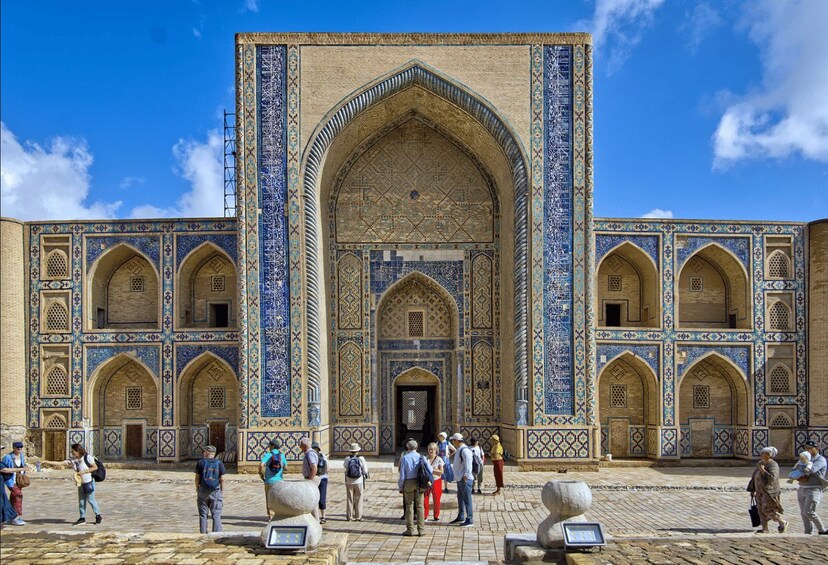
Then the heart of the old town. You stand under the Kalyan Minaret, next to a Friday mosque built for about 10,000 people. Facing it, Mir-i-Arab was for decades the only madrasah allowed to teach in the Soviet Union. Nearby, the madrasah Ulugbek built in 1417 still carries his line on the door: seeking knowledge is the duty of every Muslim man and woman.
From there the domed bazaars take over: jewellers under one dome, hat sellers under the next, money changers under the third. Under the jewellers' dome there's a teahouse where you can sit down with a pot of green tea. Near the last dome stands Magoki-Attori, a mosque that sits about 4 metres below today's street, where the city's Jews are said to have prayed in the evenings. The walk ends at Lyabi-Hauz, one of the few city pools that survived when most were filled in during the 1920s and 1930s. Legend says a Jewish widow gave up her land for it only in exchange for another plot and the right to build a synagogue.
You walk through the old markets, but nobody steers you into a carpet shop. The tour runs even if you are the only guest, and it ends near most old-town hotels and cafes. Afterwards you get a short list of workshops and restaurants that locals actually use.
Good to know: the small-group walk takes 3.5 to 4 hours, covers about 2.5 km of mostly flat streets and is limited to 10 people. The private option takes 5 hours, goes at your pace and has time for the Ark museum, with its old maps and photos (ticket extra). Entry tickets are not included in either option. Your guide tells each storey outside, and you can go in wherever you like.