


Earn OneKeyCash when you sign in and book an activity
8 Days and 7 Nights Journey through the Silk Road
By Silk Rоad Destinations
includes taxes & fees
per adult*
*Get a lower price by selecting multiple travellers
Features
- 8d
- Printed Voucher
- Instant confirmation
- Multiple languages
Overview
Our Uzbekistan tour offers a unique opportunity to immerse yourself in the country's rich culture and history. Tour participants will be able to gain insider knowledge from local guides who will unlock the secrets of ancient cities such as Samarkand and Bukhara. The tour is ideal for history buffs, culinary gourmets and those who appreciate an unforgettable cultural experience. You will get to know the traditions that have been handed down from generation to generation, taste national dishes prepared according to ancient recipes and see amazing architectural monuments. Our tour is unique because of our attention to detail and our commitment to showing Uzbekistan at its most authentic side.
Activity location
- Tashkent International Airport
- Тоshkent, Toshkent, Uzbekistan
Meeting/Redemption Point
- Tashkent International Airport
- Тоshkent, Toshkent, Uzbekistan
Check availability
8 Days and 7 Nights Journey through the Silk Road
- 8d
- English
Pickup included
Starting time: 9:00 AM
Price details
AU$3,451.81 x 1 AdultAU$3,451.81
Total
includes taxes & fees
*Get lower prices by selecting more than 2 adults
What's included, what's not
- English-speaking local tour guide during the city tours.
- Accommodation in a single or double room in hotels
- Transport by air-conditioned private vehicle with driver during the tour.
- Entrance tickets (museums and sights)
- Domestic flight Tashkent-Khiva (economy class)
- Train tickets Samarkand-Tashkent (economy class)
- Our support 24h/7
- Hotel - airport - hotel transfers with private vehicles
- Consular visa fees
- Tips for tour guides, drivers, etc.
- Lunchs and dinners
Know before you book
- Suitable for all physical fitness levels
- We can accommodate dietary needs such as vegetarian, vegan, gluten-free, etc. If you have dietary requirements. Please kindly indicate it to the special requirements at the time of booking.
- International flights are not included in the tour price
Activity itinerary
Day 1: Day 1: Flight to Tashkent
- 1 stop
- Meals: Not included
- Accommodation: Art Deluxe
Tashkent International Airport
- 30m
- Admission ticket included
Your journey to Uzbekistan begins today. You will fly to Tashkent and on arrival you will be met by the driver and tour guide and taken to the hotel. On the way you will hear general information about Uzbekistan from the tour guide.
Day 2: Day 2: Modern and ancient
- 6 stops
- Meals: breakfast
- Accommodation: Art Deluxe
Tashkent
- 8h
The city tour begins with the religious complex Hazrati Imam of the Tilla Sheikh Mosque. Another highlight is the Muyi Muborak madrasa, where you will find the holy Koran book of Chalif Osman. A little later, you will visit the Chorsu Bazaar with its fascinating oriental atmosphere. From here you continue to the Kukeldash madrasah and Independence Square.
Old Tashkent
- 1h
- Admission ticket included
Tillya Sheikh Mosque is a part of famous historical and religious complex Hast Imam, which is situated in front of Barak khan madrasah.
Tillya Sheikh Mosque consists of the winter building, summer yard, dome in the centre and the dome gallery. Huge minarets of the mosque played a role of pendulums for caravans, whose path was passed by Tashkent. Inside the minaret there is a spiral staircase, to climb up to call upon all the faithful to prayer.
The original mosque was built in 1890 by the righteous person and merchant Tillya Sheikh Ata who was selling sheeps that he was bringing from China. On the money he earned Tilla Sheikh Ata built the mosque and gigted it to the Muslims of Tashkent. Opposite the mosque there is the Barakkhana Madrassah. These two monuments and the Kaffalya Shashi Mausoleum situated to the north make the Complex being the centre (guzar) of Khazrat Imam (Khastim) makhallya and the most beautiful place.
Old Tashkent
- 1h
- Admission ticket included
Muyi Muborak madrasah 2954An iconic building of the XVI century, Muyi Muborak madrasah, is located in the old city of Tashkent. The most valuable artefact of the madrasah is the handwritten monument – Koran of Osman, which is stored in the library’s collection. The ancient manuscript dates from 644-648. In addition to Koran, the library store lots of other important literature.
Chorsu Bazaar
- 1h
- Admission ticket included
Chorsu Bazaar is located across the street from Chorsu Station of the Tashkent Metro, near Kukeldosh Madrasah. "Chorsu" is a word from the Tajik language, meaning "crossroads" or "four streams". Kukeldash Madrasah, built around 1570, is located at the edge of the bazaar. The modern building and the characteristic blue dome were designed by Vladimir Azimov, Sabir Adylov et al. in 1980, as a late example of Soviet Modernism style.
Kukeldash Madrasah
- 1h
- Admission ticket included
Kukeldash Madrasah is a medieval madrasa in Tashkent, located close to Chorsu Bazaar and Chorsu Metro station. It was built around 1570 by the Shaybanid ruler Dervish Sultan.
The madrasah is built of yellow brick, and has a traditional square shape with a big portal and an inner yard. The walls around the inner yard contain cells inhabited by the students. The portal is 20 metres (66 ft) high and contains two towers at its sides.
The madrasah was converted into a caravanserai in the 18th century, then it served as a fortress. In the 20th century it was a museum, first of atheism, and later of folk music. In the 1990s, the building became a madrasah again.
Independence Square (Mustakillik Square)
- 1h
- Admission ticket included
Independence Square is located in the centre of Tashkent city. It is a favourite resting place for the Tashkent residents. The fact that the most beautiful fountains of the city are located in the square contributed considerably to it.
Independence Square as many other places in Tashkent has its own history. Before 1865, not far from this place there was a palace of Kokand khan. In 1865 the Kokand khanate was liquidated and by order of the Russian administration and the construction of a residence for a Turkestan Governor-General began next to it. Later, this residence with a vast garden was named the White House. In the colonial period a wappenshaw was held on its ground before the General-Governor’s residence.
Day 3: Day 3: The oasis city of Khiva
- 10 stops
- Meals: breakfast
- Accommodation: Orient Star
Khiva
- 10h
- Breakfast to take with you early in the morning.
- At 05:00 transfer from the hotel to the airport by car from our agency.
- At 07:00 departure by plane to Urgench.
- At 08:30 am arrival in Urgench and meeting with our driver.
- Transfer to the hotel in Khiva to drop off the luggage (check-in from 14:00). At 10:00 am meeting with our tour guide and start your city tour.
Explore the fascinating city centre. The Ichan-Kala ("inner defence circle") historical complex is an almost intact medieval old town area in Khiva. It was the first site in Central Asia to be inscribed on the UNESCO World Heritage List. It consists of 300 traditional buildings and around 50 monuments. There are fortified towers every 30 metres along the wall.
- Juma Mosque
- The Kunya Ark fortress
- Kalta Minor
- Mohammed Amin Khan Madrasah
- The Tash Kauli Palace
- Mausoleum of Sayid Allauddin
- Madrasah of Islam
Urgench
- 1h
Urgench is a city of district significance in western Uzbekistan. It is the capital of Khorazm Province. The estimated population of Urgench in 2021 was 145,000, up from 139,100 in 1999. The city is located on the Amu Darya River and the Shavat Canal. The city is located 450 kilometres (280 miles) west of Bukhara across the Kyzylkum Desert.
You will be met in Urgench and taken to Khiva
Khiva
- 4h
Itchan Kala (Uzbek: Ichan-Qаl’а) is the walled inner town of the city of Khiva, Uzbekistan. Since 1990, it has been protected as a World Heritage Site.
The old town retains more than 50 historic monuments and 250 old houses, dating primarily from the eighteenth or nineteenth centuries. Juma Mosque, for instance, was established in the tenth century and rebuilt from 1788 to 1789, although its celebrated hypostyle hall still retains 112 columns taken from ancient structures.
Notable buildings in Itchan Kala are Konya Ark, Juma Mosque, Ak Mosque, Hasanmurod Qushbegi mosque, madrasahs of Alla-Kulli-Khan, Muhammad Aminkhon, Muhammad Rakhimkhon, Mausoleums of Pahlavon Mahmoud, Sayid Allavuddin, Shergozikhon as well as caravanserais and markets.
Itchan Kala
- 30m
- Admission ticket included
Juma Mosque is a 10th–18th century mosque in Khiva, Uzbekistan. It is one of the principal monuments of Itchan Kala, the walled old city of Khiva, which is a World Heritage Site. It stands in the middle of Itchan Kala, on the road connecting the west gate (Ota darvoza) and the east gate (Polvon darvoza). The mosque was first documented in the 10th century, but it was rebuilt in 1788.
Itchan Kala
- 30m
- Admission ticket included
Among the many historical attractions of the inner city of Khiva - Ichan-kala, the residence of the Khiva khans – the Kunya-Ark Fortress, erected at the end of the XVII century, deserves special attention.
Upon completion of the citadel's construction in 1688, Kunya-Ark turned out to be a kind of "fortress within a fortress", separated from Ichan-kala by a high clay wall. Winter and summer mosques, reception hall, women's quarters (harem), mint, stables, workshops, living rooms, etc. were located here.Military parades and training battles took place on the fortress square, there was also a prison (zindan) with a place for the execution of sentences. At the beginning of the XIX century, the citadel was restored.
Itchan Kala
- 10m
- Admission ticket included
It is difficult to imagine ancient Khiva without this monument of oriental architecture. The Minaret of Kalta-Minor has become the real symbol of the city.
It amazes with its size and unique design. Foundation of the minaret is 15 metres, diameter at the foundation is 14,5 metres and the height is 29 metres. But this massive tower has only third part of the project height.
In 1855 the Khiva ruler Muhammad Amin Khan was killed and the construction of the magnificent minaret was stopped, though it was supposed to be of 70 metres (according to other records – of 110 metres). According to the architect project wide foundation was to increase durability and the supposed top was to be narrower to decrease the load. But the fate decreed otherwise – and the tower remained unfinished. And now it resembles huge glazed barrel and is called as Kalta-Minor that means “short minaret”.
Itchan Kala
- 30m
- Admission ticket included
Muhammad Aminkhan Madrasah is an architectural monument in Khiva (1852–1855). Built by Muhammad Amin Bahadur Khan. The Madrasah is located in the western part of the Itchan Kala. It was built in 1852–1855 with the funds and decree of the Uzbek ruler Muhammad Aminkhan. Muhammad Aminkhan Madrasah is the largest and most tiled in comparison to other Khiva madrasahs.
In 1990 it was included in the list of UNESCO World Heritage Sites as a part of Itchan Kala. Currently, it is used as a tourist service and exhibition space. Khiva tourist complex hotel is located there.
Itchan Kala
- 20m
- Admission ticket included
Tash-Khauli Palace Located in the eastern part of Ichan-Kala, Tash-Khauli Palace built in 1830 - 1838 is an example of Khorezm architectural grandeur of those times. The palace was built by order of Allakuli-Khan. While it was being constructed, Khorezm had a well developed economic relations with the neighbouring kingdoms; its budget was fat. That was why the khan did not begrudge money to spend on the rich decoration of his palace.
It took 8 years to built the structure, which never pleased the khan: he wanted this big project to be completed in 2 years’ time. Many master builders lost their heads for this reason. They began the construction with the harem and khan’s chambers; then they built the mekhmonkhona ‘reception hall’ and arzonkhona ‘court’, on the eastern and western sides respectively.
Itchan Kala
- 30m
- Admission ticket included
In the historical part of Khiva, Itchan-kala, there is one of the ancient buildings of the city – Mausoleum of Sayid-Allauddin, burial vault of famous Eastern saint and Sufi sheikh. For the centuries-old history of existence it was restored many times and the exact date of the construction is unknown, but according to historians the construction was finished in the second half of XIV century.
Sayid Allauddin, being the relative of the prophet Muhammad, preached Islam in Khiva in the end of XIII century. He died in 1303 and fifty years later the mausoleum was erected on the grave of the saint. Since that time this site became one of the pilgrimage centers for believers from all over the world. Amir Kulyal is considered the architect of the mausoleum.
Itchan Kala
- 30m
- Admission ticket included
The architectural ensemble consists of the madrasah itself and a minaret almost 45 metres high. The initiator of the construction of the religious building in 1908 was a progressive figure of his time Islam Khoja, who was also the father-in-law and chief vizier of the Khiva ruler Asfandiyarkhan. Prominent masters and architects of the Khiva Khanate, including the famous master Khudojbergan Khoja and the best master ornamentalists of that time, worked on the construction of the madrasah.According to the architects' plan, the two structures were built as a game of contrasts: the highest minaret on a small territory neighbors with the smallest madrasah.Inside the madrasah you can see more than 40 prayer rooms and a large domed hall. The mihrab-prayer wall facing Mecca is decorated with elegant majolica and ganch, and the walls are lined with tiles with blue glaze.In 1910 the construction of the ensemble was completed. The height of the minaret was 44.6 metres.
Day 4: Day 4: Through the Kisil Kum desert
- 3 stops
- Meals: breakfast
- Accommodation: Komil Boutique
Bukhara
- 7h
After a delicious breakfast, you drive towards Bukhara. The route leads along ancient trade routes through the sandy desert of the Kisil Kum and past the Amu Darya River.
In the afternoon you reach the oasis city of Bukhara.
Bukhara
- 30m
The Amu Darya is a major river in Central Asia, which flows through Tajikistan, Turkmenistan, Uzbekistan and Afghanistan. Rising in the Pamir Mountains, north of the Hindu Kush, the Amu Darya is formed by the confluence of the Vakhsh and Panj rivers, in the Tigrovaya Balka Nature Reserve on the border between Afghanistan and Tajikistan, and flows from there north-westwards into the southern remnants of the Aral Sea. In its upper course, the river forms part of Afghanistan's northern border with Tajikistan, Uzbekistan, and Turkmenistan.
Bukhara
- 5h
The Kyzylkum Desert is the 15th largest desert in the world. Its name means Red Sand in Turkic languages. It is located in Central Asia, in the land between the confluent rivers Amu Darya and Syr Darya, a region historically known as Transoxania. Today it is divided among Kazakhstan, Turkmenistan and Uzbekistan. It covers about 298,000 km2
Kyzylkum is mainly located in Uzbekistan. Its territory consists mainly of an extensive plain at an altitude up to 300 m (980 ft) above sea level, with a number of depressions and highlands (Sultanuizdag, Bukantau). Most of the area is covered with dunes (barchans); in the northwest large areas are covered with takirs (clay coatings); there are also some oases. There are agricultural settlements along the rivers and in the oases. Temperatures can be very high during the summer months, from mid-May to mid-September. Kerki, one extreme inland city located on the banks of the Amu Darya River, recorded 52 °C (126 °F) in July 1983.
Day 5: Day 5: Centre of Islamic culture
- 5 stops
- Meals: breakfast
- Accommodation: Komil Boutique
Bukhara
- 8h
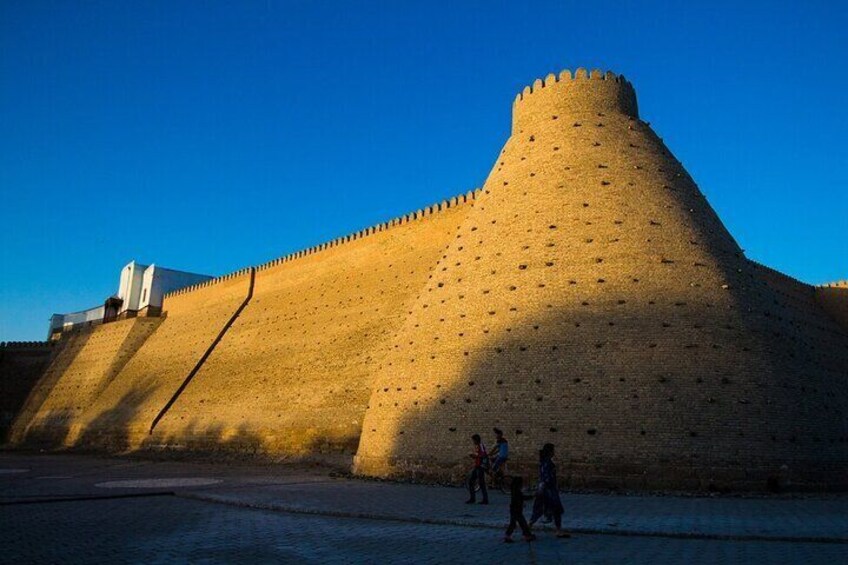
Today you will visit the old town of Bukhara. The city tour begins with a visit to the mausoleums of Ismail Samani and Chashma Ayub, before you set off to a mosque and a palace of the former emirs of Bukhara.(The Ark of Bukhara)
After a tea break, the tour continues to medreses and the Poi Kalon and Labi Hauz complexes.
Bukhara
- 1h
The Samanid mausoleum is located in the historical urban nucleus of the city of Bukhara, in a park laid out on the site of an ancient cemetery. The mesmerising tomb of Ismael Samani is an architectural bolt from the blue. The oldest, best preserved and most breathtakingly original building in Bukhara, it is without doubt oneof the architectural highlights of any visit to Uzbekistan. This mausoleum in Samani Park, completed in 905, is the town’s oldest Muslim monument and probably its sturdiest architecturally.
Bukhara
- 1h
Chashma-Ayub Mausoleum is located near the Samani Mausoleum, in Bukhara, Uzbekistan. Its name means Job's well, due to the legend in which Job (Ayub) visited this place and made a well by striking the ground with his staff. The water of this well is still pure and is considered healing. The current building was constructed during the reign of Timur and features a Khwarazm-style conical dome uncommon in Bukhara.
Bukhara
- 1h
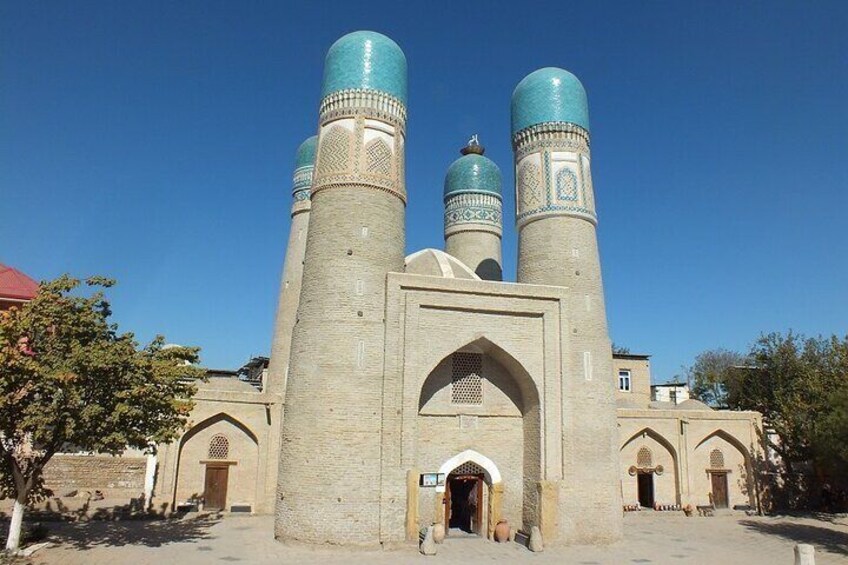
Po-i-Kalan, or Poi Kalan is an Islamic religious complex located in Bukhara, Uzbekistan. The complex consists of three parts, the Kalan Mosque (Masjid-i Kalan), the Kalan Minaret (Minâra-i Kalân) to which the name refers, and the Mir-i-Arab Madrasah. The positioning of the three structures creates a square courtyard in its centre, with the Mir-i-Arab and the Kalan Mosque standing on opposite ends. In addition, the square is enclosed by a bazaar and a set of baths connected to the Minaret on the northern and southern ends respectively.
The congregational mosque in the complex is one of the largest mosques in Central Asia, behind the Bibi Khanum Mosque in Samarkand, Uzbekistan, and the Great Mosque of Herat, Afghanistan.
Bukhara
- 1h
Lab-i Hauz sometimes also known as Lyab-i Khauz, a Russian approximation, is the name of the area surrounding one of the few remaining hauz pools that have survived in the city of Bukhara, Uzbekistan. Until the Soviet period, there were many such pools, which were the city's principal source of water, but they were notorious for spreading disease and were mostly filled in during the 1920s and 1930s.
The Lab-i Hauz survived because it is the centrepiece of a magnificent architectural ensemble, created during the 16th and 17th centuries, which has not been significantly changed since. The Lab-i Hauz ensemble, surrounding the pool on three sides, consists of the Kukeldash Madrasah (1568–1569, the largest madrasa in the city), on the north side of the pool, and two religious edifices built by Nadir Divan-Beghi: a khanqah (1620; Uzbek: xonaqah, meaning a lodging house for itinerant Sufis) and a madrasa (1622), which stand on the west and east sides of the pool respectively.
Day 6: Day 6: Discoveries in Samarkand
- 3 stops
- Meals: breakfast
- Accommodation: Zilol Baxt
Samarkand
- 8h
Today you drive to Samarkand. On the way, you will see a ceramics workshop, the remains of an 11th century caravanserai and a water reservoir for caravans. You will spend your lunch break in the small village of Mitan with an Uzbek family.
The afternoon offers you the opportunity for a city tour before you set off for Samarkand's landmark, Registan Square. This place is particularly enchanting when illuminated in the evening.
Gijduvan ceramics of The Narzullaevs
- 1h
- Admission ticket included
Such cities as Bukhara and Samarkand have been famous for their ceramics, but not only in large cities lived skilled craftsmen. Gijduvan is distinguished by its unique, particularly recognisable all over Uzbekistan school of ceramics.
Gijduvan ceramics school has its deep roots. The skills have been passed from father to son from generation to generation. Today Gizhduvan is home for the sixth generation of potters from Narzullayevs family which glorified Gijduvan school ceramics all over the world.
The works of Gijduvan masters are available for familiarisation not only at the potter workshops but also in the Gijduvan Museum of Ceramics. The museum exhibits a large collection of modern masters. They are noted for rich colours and a variety of ornaments. Gijduvan School of ceramics is distinguished by a geometric pattern. Green and blue colours prevail in decoration of products.
Registan
- 2h
- Admission ticket included
The Registan Square is a real gem located in the very heart of the ancient city of Samarkand. It has gained its worldwide fame thanks to the great architectural ensemble that has become a monument of the oriental architecture. From three sides, the square is surrounded with grand madrassah, portals of which are facing the centre of the space. All three erections have their own unique décor. It is by virtue of these buildings, preserved on the territory of the city, Samarkand was included in the UNESCO World Heritage List in 2001.
Day 7: Day 7: Other highlights in Samarkand
- 6 stops
- Meals: breakfast
- Accommodation: Art Deluxe
Samarkand
- 9h
This morning, you will drive to the Shashi Zinda necropolis, where two important burial sites are located. You will continue your sightseeing at the Bibi Chanum Mosque and a colourful bazaar. In the afternoon, you will visit the mausoleum of the Prophet Doniyor and the Afrasiab History Museum.
Shortly afterwards, you will be taken to the train station for the train journey to Tashkent.
Shah-i-Zinda
- 1h
- Admission ticket included
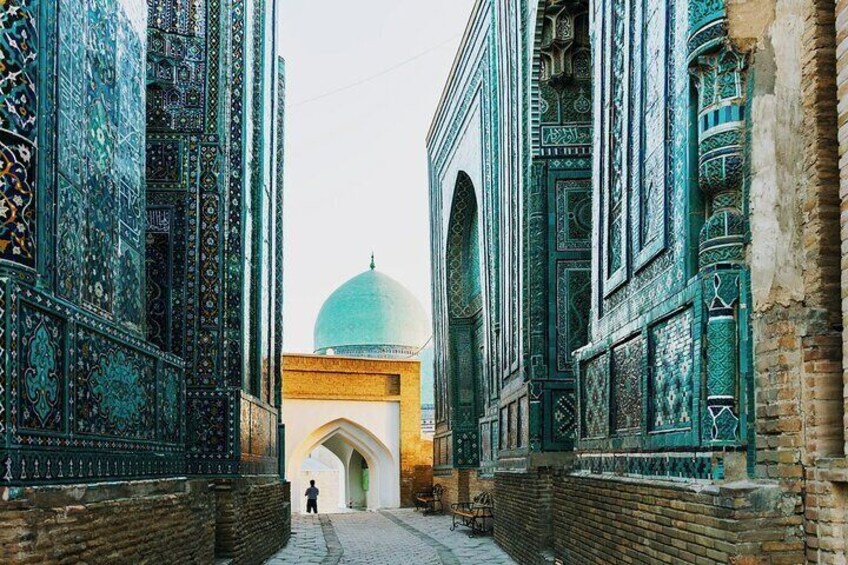
Shah-i-Zinda is a necropolis in the north-eastern part of Samarkand, Uzbekistan.
The Shah-i-Zinda Ensemble includes mausoleums and other ritual buildings of 11th – 15th and 19th centuries. The name Shah-i-Zinda (meaning "The living king") is connected with the legend that Qutham ibn Abbas, a cousin of Muhammad, is buried here. He came to Samarkand with the Arab invasion in the 7th century to preach Islam.
The Shah-i-Zinda complex was formed over eight (from the 11th until the 19th) centuries and now includes more than twenty buildings.
Bibi Khanym Mosque
- 1h
- Admission ticket included
The Bibi-Khanym Mosque is one of the most important monuments of Samarkand, Uzbekistan. In the 15th century, it was one of the largest and most magnificent mosques in the Islamic world. It is considered a masterpiece of the Timurid Renaissance. By the mid-20th century, only a grandiose ruin of it still survived, but major parts of the mosque were restored during the Soviet period.
Samarkand
- 1h
Everyone has heard of Daniel and the lion's den, but few people could tell you that his final resting place, the Mausoleum of Daniyar (Tashkent; 09.00-18.00 daily), is in Samarkand, on the northern edge of Afrosiab by the healing spring. Daniel (Daniyar in Uzbek) is considered a patron saint and protector of Samarkand, and brings wealth and prosperity to the city.
According to legend, Khodja Daniyar was a companion of Kusam ibn Abbas, who was believed to be a relative of the Prophet and one of the first Islamic preachers in Central Asia. Other legends associate Khodja Daniyar with the Koranic and Biblical prophet Daniyar (Daniel) whose remains were brought here by Amir Temur.
Afrasiyab Museum
- 1h
- Admission ticket included
Afrasiab Museum of Samarkand is a museum located at the historical site of Afrasiyab, one of the largest archaeological sites in the world and the ancient city that was destroyed by the Mongols in the early 13th century. Museum building and the archaeological site are located in the north-eastern part of the city of Samarkand in the Central Asian country of Uzbekistan. It bears the name of Afrasiab, mythical king and hero of Turan. Permanent exhibition of the Afrasiab Museum of Samarkand is focused on the history of the city itself as well as the surrounding region. The museum building was designed by Armenian architect Bagdasar Arzumanyan in 1970, at the time when Uzbek Soviet Socialist Republic was still part of the Soviet Union.[1] The opening of the museum was dedicated to the 2500th anniversary of the founding of the city of Samarkand.Thematically, the museum is divided into five rooms dedicated to different periods of life in the fort of Afrasiyab.
Tashkent
- 30m
arrival in Tashkent and transfer to hotel
Day 8: Day 8: Goodbye and have a safe flight home
- 1 stop
- Meals: breakfast
- Accommodation: Not included
Tashkent International Airport
- 2h
- Admission ticket included
In the morning you will be taken to the airport. There you will say goodbye to the tour guide and driver. We look forward to welcoming you back soon.
Have a good flight!
Location
Activity location
- Tashkent International Airport
- Тоshkent, Toshkent, Uzbekistan
Meeting/Redemption Point
- Tashkent International Airport
- Тоshkent, Toshkent, Uzbekistan
Best Deals on Things to Do
Experience the wonders of the world up close with great deals on things to do near and far. Expedia offers one-of-a-kind activities that allow you to explore Тоshkent your way. Whether you love nature, culture, food or a bit of adventure, we have the perfect activity for you.
Top experiences in Тоshkent
With so many activities in Тоshkent, planning the perfect day out may seem like a daunting task. Expedia is here to take the hassle out of finding the best attractions, tours and activities in Тоshkent. Families, couples and business travellers can all find the perfect activity in Тоshkent to create life-long memories with the help of Expedia.