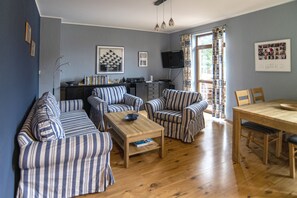
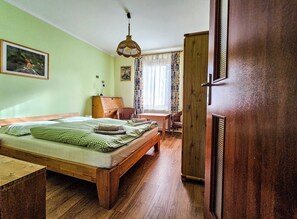
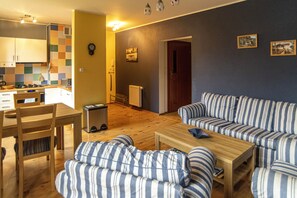
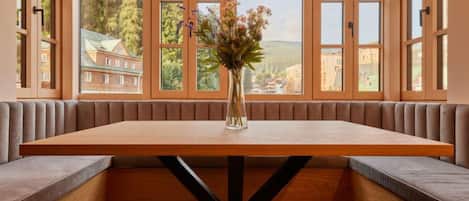
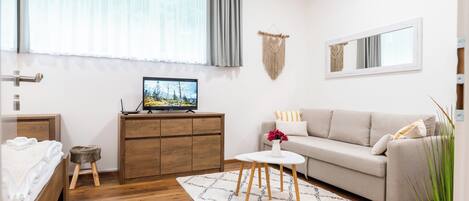
3-room apartment, 65 m², in a modern apartment building. Spacious and beautifully furnished. Living/dining room with satellite TV, DVD recorder, and stereo system. 2 bedrooms, open-concept kitchen with 4 hot plates, oven, microwave, and dishwasher. Modern bathroom with shower and separate toilet. Balcony/patio facing southwest, new balcony furniture, and a garden grill. Beautiful view of the mountains and the countryside.
Karpacz (Krummhübel) and the Karkonosze Mountains
The Karkonosze Mountains are a low mountain range with an alpine character, characterised by rounded, bare peaks, deeply incised valleys, steep slopes, and fascinating vistas. The Sněžka massif, with its 1,602-meter-high peak, is the highest mountain in Central Europe north of the Alps—a fact that becomes strikingly apparent once you’re up there. Like the Hohe Rad (1,509 m), the Große Sturmhaube (1,424 m), the Veilchenspitze (1,471 m), and the Reifträger (1,362 m), the Koppe lies on the mountain ridge that extends roughly in a west-east direction. This mountain range is the backbone of the Karkonosze Mountains and leaves its unmistakable mark on them. The main ridge marks the border between Poland and the Czech Republic. It forms the watershed between the Elbe and the Oder. The ridge is about 35 km long and runs from Przelecz Szklarska in the west to the Pomezni boudy (border huts) in the east. Karpacz lies at the foot of Schneekoppe, which is clearly visible from here and can be climbed with or without the aid of a lift. It is the most famous climatic health resort in the Polish part of the mountains. The town was first mentioned in 1599 as a settlement on the “Krummen Hübel,” between the Little and Great Lomnitz. At that time, lumberjacks, charcoal burners, and herdsmen lived here. It wasn’t until the 17th century that the trade that would make the town famous emerged: the production of herbal medicines. The “laboratory assistants,” as the herb gatherers called themselves, achieved considerable prosperity through this trade. The village, situated at an elevation of 600–800 metres, is spread out over a wide area. Pilgrims heading to the St. Lawrence Chapel on Schneekoppe—which was consecrated in 1681—were the first tourists in the Giant Mountains and would stop in Krummhübel along the way. From the small hill, which can be reached in 15 minutes by chairlift, it is only a 30- to 45-minute walk to Schneekoppe. The most famous landmark in the village is the Wang Church. The wooden church was built in southern Norway in the early 13th century. Prussian King Frederick William IV had the church—which was slated for demolition due to its dilapidated condition—purchased at auction and transported to Berlin, where it was to be rebuilt on Peacock Island. Through the mediation of Countess von Reden from Buchwald (Bukowiec), the church came to Karpacz and was consecrated in 1844.
Hiking Opportunities
The Giant Mountains are a hiker’s paradise. The trails, some of which follow ancient routes, are well-marked in both the Polish and Czech sections and can be easily combined. Their terrain varies. Hikers should be prepared for rocky, steep, and rugged sections. In the lower regions, you’ll encounter beech and mixed forests; higher up, spruce trees dominate the landscape. Rare plants can still be admired in wetland habitats, mountain meadows, and in the hollows of former glaciers. To protect the flora and fauna of the Karkonosze Mountains, the area around the Schneegruben—home to many rare bird species—was designated a nature reserve as early as the 1920s. Today, there is a national park on both the Polish and Czech sides. A hike along the ridge trail at an elevation of 1,300 to 1,500 metres is the highlight of any visit to the Karkonosze Mountains thanks to the magnificent views. Experts recommend the route from Szrenica in the west to the border huts in the east, as the scenic beauty increases from west to east and the mountains grow ever higher. The mountain huts—cosy wooden cabins where you can also spend the night—are characteristic of the Krkonoše Mountains and are very popular with hikers and skiers. The huts on the Czech side offer higher quality accommodation. Road and hiking maps, as well as travel and hiking guides—which you’re welcome to use—are available in the